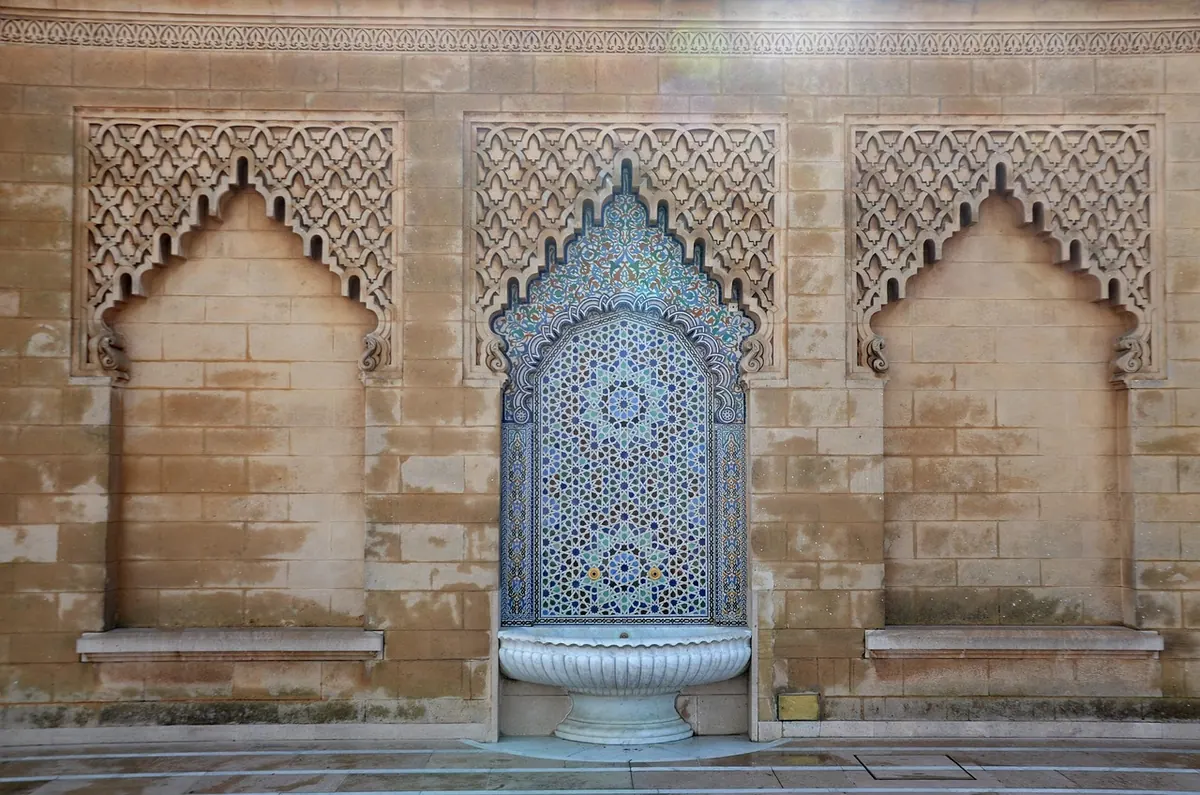
A stone wall holds the day's heat long after the sun has left the courtyard. By evening it is still faintly warm to the touch, and the vines trained across it have gone from green to near-black. This is the moment the lighting has to earn its place. Not by flooding the space, but by picking out the texture of the stone, the edges of the leaves, and the shape of a doorway you would otherwise walk past.
Courtyards like this are forgiving in daylight and unforgiving at night. A single badly aimed fixture turns a beautiful wall into a flat, chalky surface. A well-chosen lantern makes the same wall look older, softer, and considerably more inviting. The ideas below are the ones that hold up in real courtyards, on real stone, with plants that keep growing.
Read the Stone Before You Choose the Fixture
Stone is not a neutral backdrop. Limestone, sandstone and tufa have warm, honeyed tones that deepen under a low colour temperature. Grey granite, basalt and smooth concrete go cold and slightly blue if the light is too white, which is why so many Mediterranean courtyards look better with lamps around 2700K than with anything labelled "daylight".
Texture matters as much as colour. Rough render, split-face stone and deep mortar joints respond beautifully to light that grazes across them at a shallow angle, because every bump casts a small shadow. Polished or very smooth surfaces do the opposite: they reflect the source and can look patchy. If your wall is dark and porous, it will swallow light, so plan on slightly more output or a wider beam than you would use on pale limestone.
Before buying anything, stand in the courtyard at dusk with a torch. Hold it close to the wall, then further away. Move it above your head, then down to knee height. You will learn more in ten minutes than from any showroom display.
Where to Place Wall Lanterns
Good placement follows the architecture rather than an even rhythm. Light a doorway, a gate pier, the springing of an arch, the end of a low wall, the corner where two façades meet. A lantern on a long blank stretch of stone has nothing to do except advertise itself.
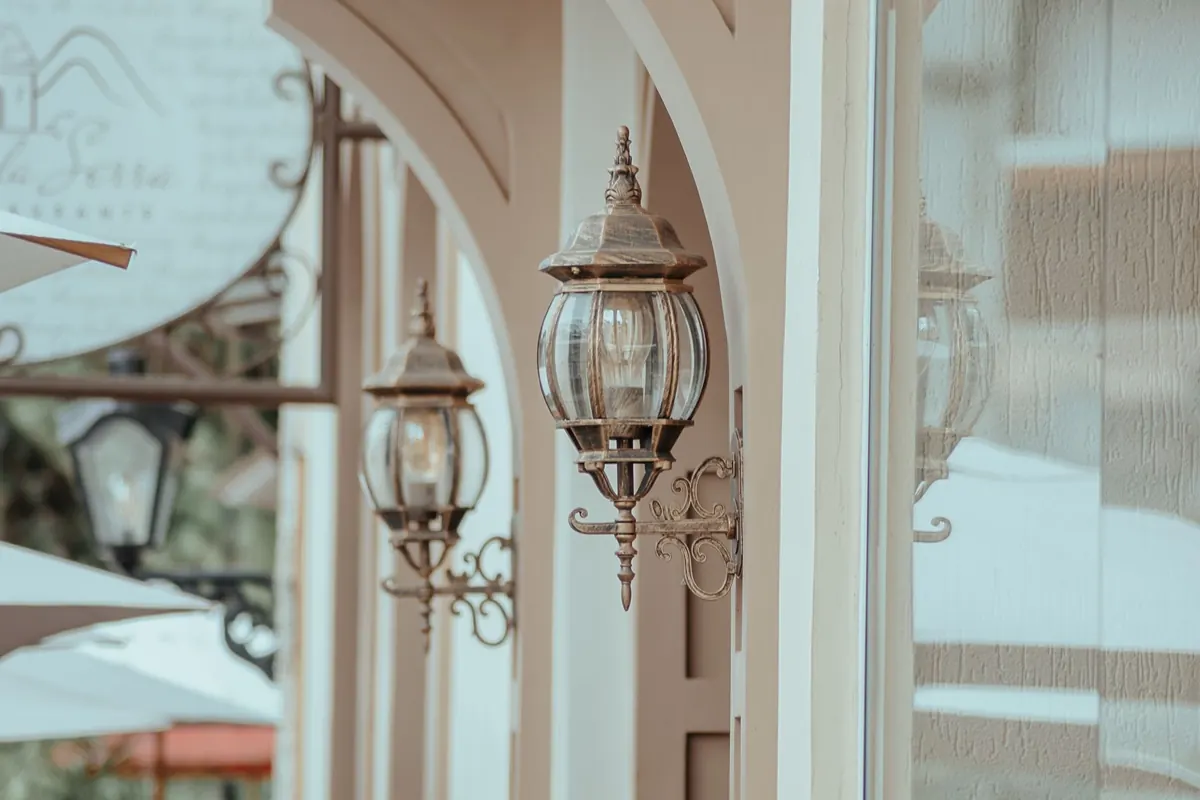
For a doorway, fix the lantern to one side rather than directly above, roughly 30 to 40 cm from the frame. The centre of the glass should sit around 1.8 m from the ground, close to the top of the door. Slightly lower works well on a wide opening; slightly higher suits a tall, narrow one. What you are avoiding is a bright source at eye level, which is the single most common reason a courtyard feels uncomfortable at night.
Along a long wall, spacing of roughly 2.5 to 3.5 m gives overlapping scallops of light with no dark gaps between them. Wider spacing creates separate pools, which suits a rustic wall better than a formal one. A short checklist before you drill:
- Mark the lantern positions in masking tape and look at them in daylight and after dark.
- Check that no fixture sits directly above a seating position or a dining chair.
- Keep light out of the neighbours' windows, especially where walls are shared.
- Choose downward-facing lanterns on walls; they throw a soft scallop and hide the bulb.
- Confirm the wall construction. Stone veneer, cavity walls and solid rubble need different fixings.
Warm Colour, Dimming, and Comfortable Glare
Aim for 2700K across the courtyard, with a high colour rendering index so the stone, terracotta and foliage keep their colour instead of going grey. Small LED lamps of four to six watts are usually enough for a wall lantern; more output on a short wall simply creates glare.
Dimming is what separates a courtyard that feels like a room from one that feels like a car park. Take the wall lights down to roughly 30 to 50 percent after dinner, and let candles or a floor lantern carry the last hour. A simple photocell or timer means the lights come on at the right moment without anyone hunting for a switch.
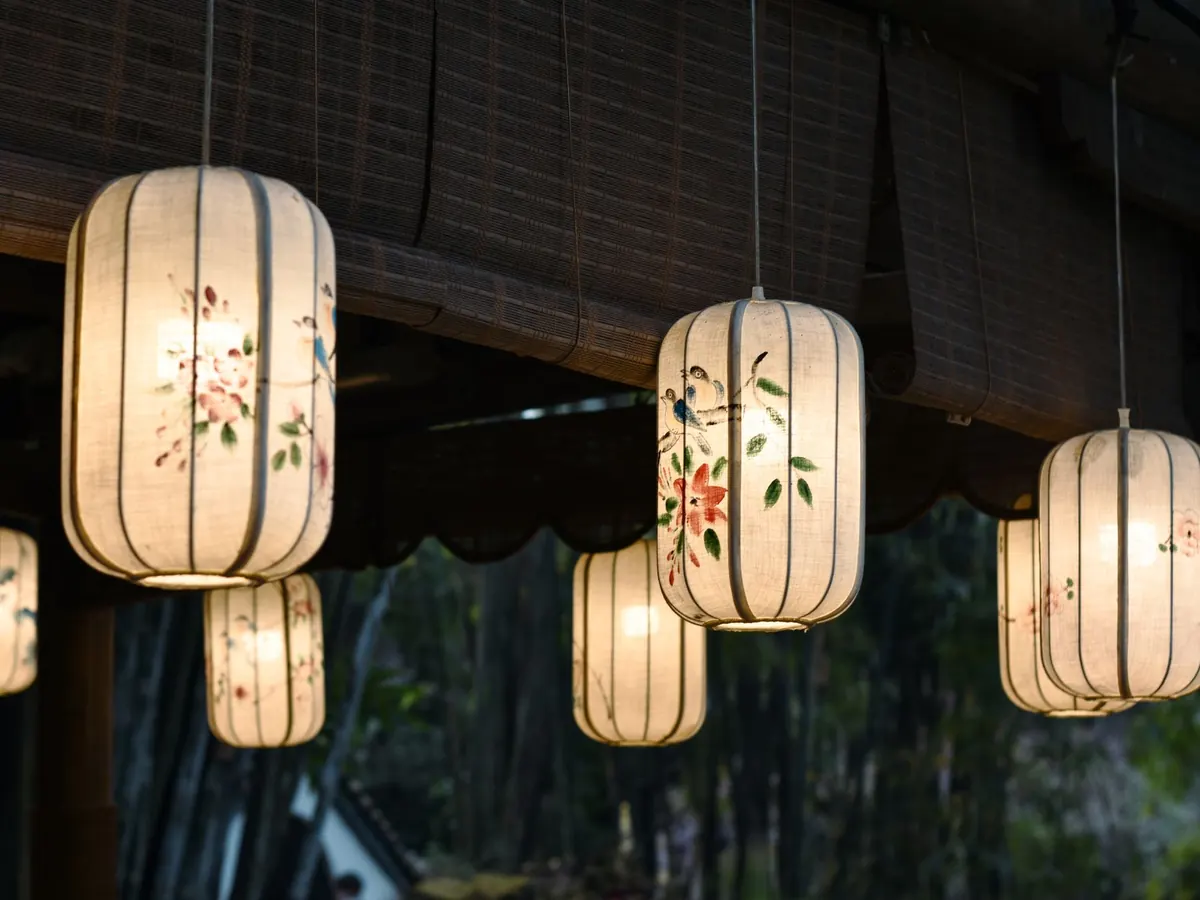
Glass choice matters too. Clear glass with a visible bulb reads as a bright point; frosted, seeded or amber-tinted glass spreads the light and softens the effect on stone. If your lantern has no diffuser, look for one with a baffle or an opal inner shade.
Turning Climbing Plants into Shadow Play
Jasmine, bougainvillea, grapevine, wisteria and ivy all behave differently in light, but the principle is the same: illuminate the structure of the plant, not the mass of leaves. A narrow uplight placed 30 to 60 cm from the wall and angled at roughly 45 degrees will pick out stems and cast leaf shadows upwards across the stone. Move the fixture further out and the shadows spread wider and softer.
Wall lanterns do a different job. A lantern fixed beside a mature jasmine throws leaf shadows sideways across the wall, and those moving silhouettes are half the pleasure of an evening courtyard. Place the lantern so the foliage sits between it and the wall, but keep at least 30 cm of clear space around the fixture for heat and for pruning access.
Two practical notes. Plants hold moisture, so fixtures near dense growth need a proper outdoor rating and sealed cable glands. And keep light low rather than aimed up into the leaves from directly beneath, which flattens the foliage and can leave you staring into a bright source.
Lighting the Layers Below the Wall
Wall lanterns alone make a courtyard feel top-heavy. Work in three heights: something low near the ground, something at table level, and the wall lights above. A floor lantern of 30 to 40 cm beside a step, a small lamp on an outdoor table, a warm path light at the edge of gravel, a single uplight in a large olive pot. Each does a little; together they make the space feel furnished.
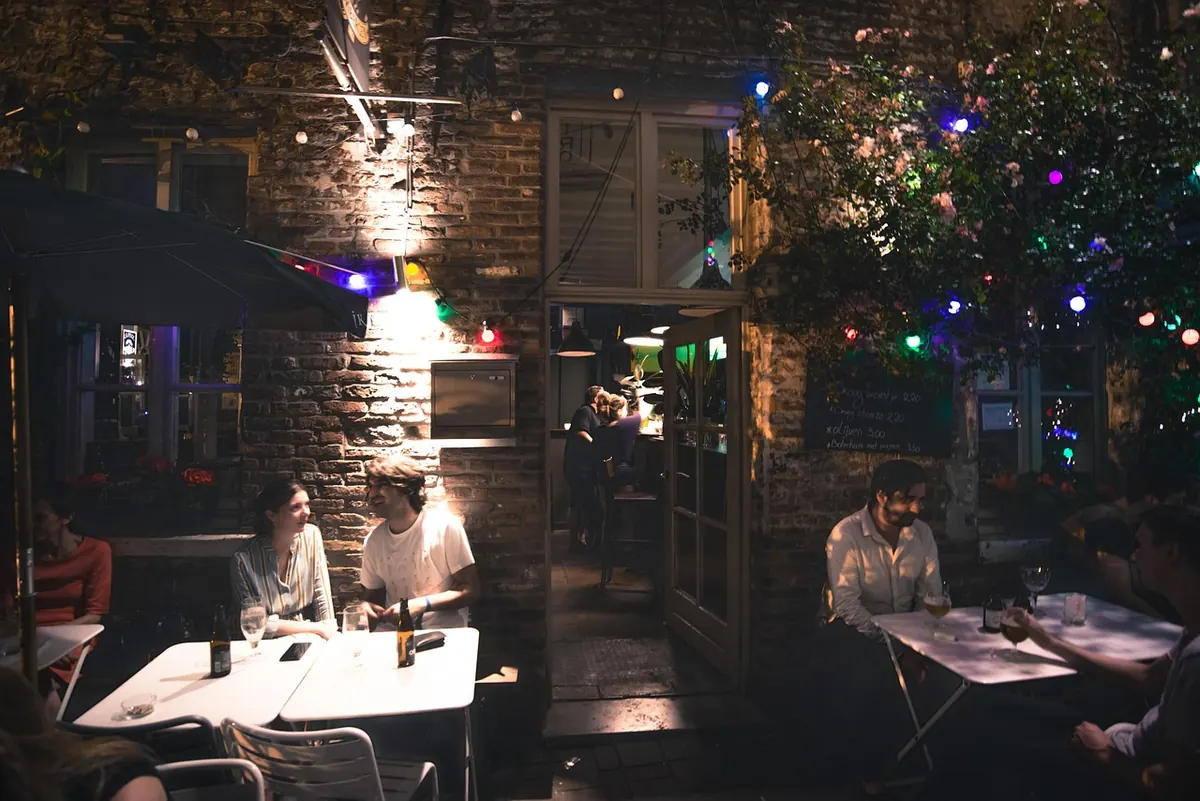
String lights under a pergola or across a wall are fine in small doses, provided they run on a dimmer and stay warm rather than icy. Candles in glass hurricanes on a stone ledge add flicker that no bulb imitates well. If your courtyard has a fire bowl or a chimney, keep electric light away from it and let the flame be the brightest thing in the scene.
Weatherproofing and Upkeep
Under a roof overhang, an IP44-rated fitting is usually adequate. Fully exposed walls need IP65, and coastal courtyards need fixings and bodies in brass, bronze or marine-grade stainless, since salt air will find every cheaper alloy. Powder-coated aluminium is a reasonable middle ground inland.
Run cable in conduit, keep junction boxes above ground level where water cannot pool, and have mains connections made by a qualified electrician. Check seals and wipe the glass every few months, particularly where vines shed flowers and dust. Brass will darken and patinate; that is usually an improvement on a stone wall, so resist polishing it back to shine.
A Simple Evening Setup
If you are starting from scratch, this sequence works in most Mediterranean courtyards of modest size:
- Fit one warm 2700K lantern to the side of the main doorway and set it on a dimmer.
- Add two more wall lanterns along the longest wall, spaced 2.5 to 3.5 m apart.
- Place one small floor lantern or path light at the step or threshold.
- Add a single ground uplight aimed into the climbing plant, angled to graze the wall.
- Set everything to a timer, then reduce the wall lights by half after dinner.
Live with it for a week before adding anything else. Most courtyards need less light than their owners expect, and the best results come from moving one fixture 20 cm rather than buying another. Stone, leaves and warm light do the rest.
Photo: bouassa / Pixabay